Making a Bee Hotel
Research into bee hotels reveals two designs. Timber types for the majority of bees including Resin Bees, Leafcutter Bees, Wasp Mimic Bees, Masked Bees, Reed Bees and Carder Bees(the only non-aussie bee that will use the hotel). All of these bees will want to make a home in the timber style bee hotel I have made. The other type of hotel is a clay hotel inhabited by the Bluebanded Bee.
Honey bees, an introduced bee to Australia and very common in the backyard and also responsible for the majority of our honey consumption does not colonise in the hotel but in a bee box.
To make a bee hotel all you need is a reasonably water resistant cavity such as a box. I have seen recycled items such as washing machine tubs and TV cabinets used for bee hotels. Fill the cavity with wood that has holes drilled in it or bamboo or pithy stems such as lantana. And "Wa-Lah" there you have it, your very own bee hotel (no Laaa pun intended). Attach it to the fence or a post or a tree between 1m and 1.5m off the ground.


I decided to cut out a bit of tin and place it over the top of the roof to give it more shelter. No bees yet!!!


To make the clay bee hotel I used a besser block but any cavity that is sturdy will do such as a plastic or teracotta drain pipe. Mix up some clay and slap it in the cavity. Before it sets poke holes in the clay. Place the hotel up against a wall somewhere against the house or shed close to flowering plants.


Below is a snipet from "Aussie Bee" a very good website for everything about bees. Here is the link.
https://www.aussiebee.com.au/index.html
For Resin Bees, Leafcutters and Reed Bees, make many small bee hotels and set them up in different parts of your garden. This mimics the natural situation: in the bush, the pithy stems or holes in timber, that these native bees use for their nests, are fairly scattered. Researchers have found that pests and parasites may build up excessively in very large bee hotels or 'bee walls' and this can cause a drop in bee numbers over time.
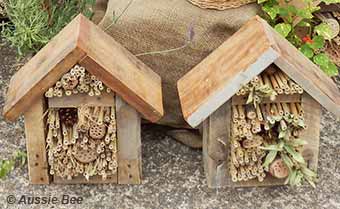
Here are two small Bee Hotels made from bamboo canes and drilled timber blocks -- available from the Secret Garden, Richmond NSW.
For Blue Banded Bees, place the clay nest blocks in groups. In the bush, these bees often build in quite dense clusters. Their nest sites are like a large village with dozens of individual nests. The scent of the nests encourages other bees to build in the site. So if you want to make some clay nest blocks for Blue Banded Bees, you should place them in groups of about ten blocks. Small isolated clay blocks are unlikely to attract Blue Banded Bees.
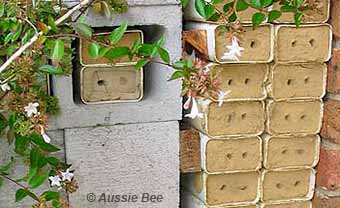
These clay blocks for blue banded bees are set up in a group.

Whoa! Very interestink! Thanks!
ReplyDelete